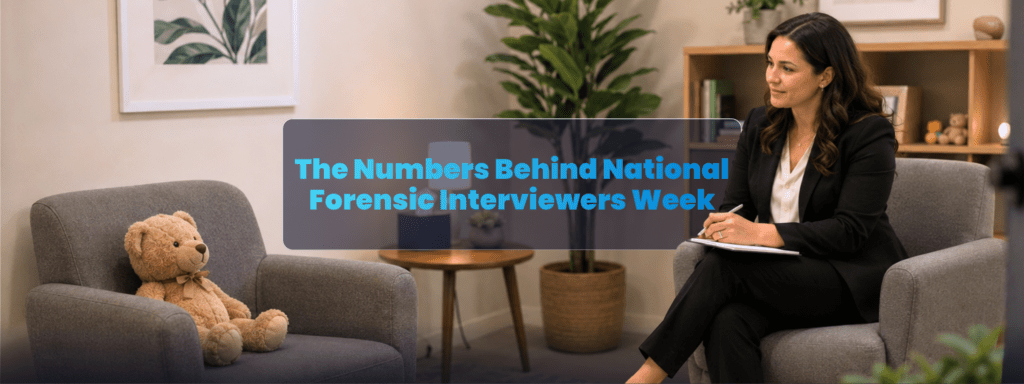
A kid walks into a small room with soft chairs and a box of tissues nobody talks about. Maybe there’s a drawing on the wall a previous kid made. The forensic interviewer sitting across from them has done this hundreds of times. The kid has done it zero.
That mismatch, one person’s routine Tuesday against another person’s first and only time, is the whole job. It’s also easy to lose sight of when you’re buried in scheduling, documentation, and the fortieth follow up call of the week. So during National Forensic Interviewers Week, it’s worth stepping back and looking at the actual numbers behind why this work exists and why it’s harder than it looks from the outside.
That kind of appreciation shouldn’t only show up once a year, and most days, honestly, it doesn’t get said out loud at all. National Forensic Interviewers Week is different on purpose. It’s not spread across a whole system or measured by case outcomes. For one week, it’s specifically, intentionally, about the people doing the part nobody else sees. About you.
Three stood out.
01 The scale
Bigger than most people understand.
At least 1 in 4 girls and 1 in 13 boys in the United States are estimated to experience child sexual abuse before they turn 18, according to the Centers for Disease Control and Prevention (CDC).
1 in 4 girls experience child sexual abuse before age 18.
1 in 13 boys experience child sexual abuse before age 18.
That’s not a niche problem serving a small population. That’s every classroom, every youth sports team, every church group you’ve ever been part of. The CDC is upfront that even these numbers likely undercount reality, since so much abuse is never reported at all. Which brings us to the second stat.
02 The exception
Most kids never say anything right away.
Roughly 1 in 5 child sexual abuse victims never disclose their abuse to anyone, full stop. Most who do disclose wait years, not days, if they have the option.
Children served by CACs nationally.
CAC cases involving sexual abuse allegations.
So when a child does sit down in that room and start talking, it’s not a routine data point. It’s a rare thing happening. In 2025 alone, Children’s Advocacy Centers (CACs) across the country investigated 224,520 cases involving sexual abuse allegations, more than half of everything CACs handled that year. Each one of those cases exists because, at some point, someone finally had the words, and someone trained well enough to be trusted with them was sitting there to listen.
That’s the actual job description. Not “conduct an interview.” More like: be the one person in a kid’s life who makes disclosure possible at all.
03 The weight
The people doing this are stretched thin, and it's not new.

Here’s the harder truth. Turnover across child welfare and related child-serving fields has hovered around 30% a year for more than a decade, a trend a December 2024 workforce analysis confirmed is still very much alive. It’s part of why the National Children’s Alliance (NCA), the organization that accredits CACs nationally, relaunched its national CAC staffing and salary survey in 2024, trying to get a current read on a field that keeps losing experienced people to burnout, low pay, and the weight of the work itself.

“I do this work to give children their power back.”
Colleen Brazil, Vice President of Children’s Services at Project Harmony
As Colleen Brazil, Vice President of Children’s Services at Project Harmony, put it in Guardify’s tribute to forensic interviewers, “I do this work to give children their power back.” That’s the why. But the why doesn’t necessarily acknowledge you, and it certainly doesn’t undo secondary trauma. The people carrying that mission are human, and the data says the field is asking a lot of them.
If any of that landed a little too close to home, that’s kind of the point of putting it here. The exhaustion isn’t a personal failing, and it isn’t just you. It’s a documented, field-wide pattern, which means somewhere else in the country right now, another interviewer, advocate, or investigator is carrying the exact same weight you are.
Why this week
Because the work deserves to be seen.
So before anything else: thank you.
Guardify started National Forensic Interviewers Week five years ago because this job doesn’t get much visibility outside the multidisciplinary team (MDT) itself, the interviewers, advocates, investigators, prosecutors, and medical providers who all touch a case. Nobody outside the field really knows what a forensic interviewer’s week looks like, or what it costs to do it well, year after year. This week isn’t about Guardify. It’s about making sure the people who show up for kids get shown up for too, even if it’s just one week where the rest of the world pays attention.
If you’re reading this and you’re one of these professionals, on any part of the team; this work is rare, it’s necessary, and it’s heavier than people give it credit for. You do it anyway, week after week, case after case. That deserves to be said out loud, not just felt quietly.
5th Annual Guardify Awards
Learn more about this year’s recipients.
If you are reading this and you are one of these professionals, on any part of the team, this work is rare, necessary, and heavier than people give it credit for. You do it anyway, week after week, case after case. That deserves to be said out loud.
View Award RecipientsWant to go deeper?
Sources and further reading.
Use this section for the final blog references, including CDC prevention data, NCA CAC service statistics, disclosure research, workforce analysis, and forensic interviewer burnout research.